
You are welcomed into the world of Dragonfly with a simple but potent metaphor.
Four stages. Egg. Nymph. Molting. Dragonfly. A life cycle that mirrors our own, the continual shedding of past selves as we grow, falter, dare and begin again.
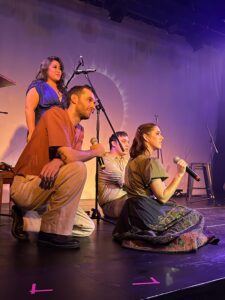
NYMPH, the adolescent stage of Dragonfly, invites us into a fantasy realm where a Sleepwalker, a Daydreamer, a mythical tree and a collective of enchanting Poets inhabit a world that has suddenly gone dark. Two strangers, Luna and Sol, cross paths. Through unexpected conversation, deeper truths surface. It is gentle, philosophical, and quietly hopeful.
Composer and performer Jennifer Trijo has written every song and scene across several years, and that dedication is evident. The musical language feels cohesive and intentional. Themes introduced early return with emotional resonance. There is care in the architecture of the work.
The harmonies were beautiful. Rich and balanced, they carried a sense of emotional clarity that settled over the room. The musical talent of the performers was excellent. I loved their voices, not only for their technical control but for the sincerity behind them. Sophie Volp brings warmth and emotional intelligence to Luna. Joey Haenen’s Sol has openness and grounding. The Poets, Gabriel Sharra, Ellie Esdene McMahon and Max Garcia-Underwood, add texture and tonal depth to the sonic landscape. Each voice carried strength and clarity, blending seamlessly while still retaining individual character.
And then there was the piano. Emma Knights was brilliant in her accompaniment. Sensitive, intuitive and musically astute, she found exactly the right tone for every moment. Her playing never overpowered, never distracted. Instead, it supported, lifted and deepened the storytelling. There was empathy in her phrasing, a careful listening that allowed the narrative to breathe. Her sensitivity shone through and felt entirely befitting of the story being told.
This is presented as a hybrid concert version, prioritising music and libretto over set, choreography and spectacle. Projections suggest time and space, the rest is left to imagination. That restraint works. It places the focus squarely on voice, lyric and connection.
The central idea of transformation lands softly but meaningfully. There is an invitation here, not to be dazzled, but to reflect. To consider the skins we have shed. To sit with uncertainty. To find light in darkened moments. The connection between Luna and Sol is tender and unforced, and the sense of hope that Trijo speaks of in her notes does resonate.
I can absolutely see this as a full scale musical theatre production. The world is rich, the music strong, the metaphor clear. But even in this staged concert form, it stands as an excellent and deeply enjoyable performance in its own right. It lingered with me, not in a loud way, but in a thoughtful one.
Four and a half stars for a work that dares to dream, and invites us to do the same.
Two shows remaining on 5 March 2006. Tickets available here.
